

About Us
MAYAPUR HARE KRISHNA SANKIRTAN MOVEMENT
Welcome To
Mayapur Hare Krishna Sankirtan Movement
Mayapur Hare Krishna Sankirtan Movement is a West Bengal-based spiritual organization dedicated to promoting Krishna Consciousness through devotional practices and community service. Incorporated in 2016, its sole mission remains to foster a deep connection with Lord Krishna and Lord Shri Chaitanya Mahaprabhu to enrich lives and spread the divine message of love and devotion. Spread by His Divine Grace A.C. Bhaktivedanta Swami Srila Prabhupada, Founder-Acharya of the worldwide International Society for Krishna Consciousness (ISKCON) embarked on its journey towards spiritual growth and community welfare.
Mayapur Hare Krishna Sankirtan Movement is registered with the Registrar of Societies and the type of NGO is Trust (Non-Government) bearing the Indian Trust Act and the Registration Number is S/2L 56486. The city and state of registration are Bardhaman and West Bengal. The date of registration is 27-05-2016. Our Unique Id of VO/NGO is WB/2024/0411260.

What is the Hare Krşņa Movement?
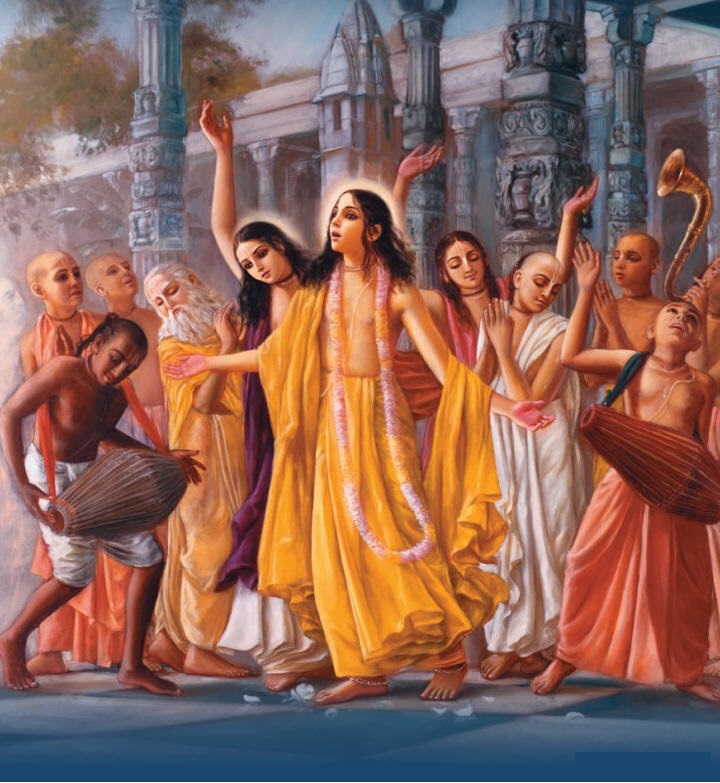
The International Society for Krishna Consciousness (ISKCON) was formed in 1966 by His Divine Grace A.C. Bhaktivedanta Swami Prabhupāda, who came from India on the order of his spiritual master to preach the love of God to the people of the West. Śrīla Prabhupāda is in a line of disciplic succession going back directly 500 years to the time when Lord Caitanya appeared in India, and from there back still further-5,000 years to the time when Lord Śrī Krşņa first spoke Bhaga- vad-gītā.
Krşņa consciousness is experienced as a process of self-purification. Its means and end are an open secret, and there is no financial charge for learning Krşņa consciousness or receiving initiation into the chanting of Hare Krşņa. The gist of devotional service to Krşņa is that one takes whatever capacity or talent he or she has and dovetails it with the interests of the supreme enjoyer, the Lord, Śrī Krşņa. The writer writes articles for Krşņa, and we publish periodicals in this way. The businessman does business in order to establish many temples across the country. The householders raise children in the science of God, and the husband and wife live in mutual cooperation for spiritual progress. These activities are done under the sanction of the expert spiritual master and in line with the scriptures. Devotional service in Krşņa consciousness means regular chanting in the temple, hearing talks about the pastimes of Krşņa from Śrīmad- Bhāgavatam, and taking foodstuffs pre-prepared for and offered to the Supreme Personality of Godhead.
By books, literature, and chanting, the Society is dedicated to awakening the worldwide public to the normal, ecstatic state of Krşņa consciousness, so that all may regain their eternal position of favorably serving the will of Krşņa. Sankīrtana-congregational chanting- is carried to the people in public parks, schools, on television, in the theater, and on the streets. Krşņa consciousness is not an idler’s philosophy. Rather, by – chanting and engaging in the service of Krşņa, anyone who takes part will experience the state of “samādhi, ” ecstatic absorption in God’s consciousness, – twenty-four hours a day!
Since the philosophy of Krşņa consciousness is non-sectarian, any man, Hindu or Christian, etc., will become better in his faith by chanting the holy name of God and by hearing the Bhaga- vad-gītā. Without knowledge and realization and loving service to the one Supreme God, there can be no religion. Let everyone rejoice in the sankīrtana movement, and we may see the fulfillment of the prediction made by Lord Caitanya 500 years ago that the chanting of the holy names of God, Hare Krşņa, would be carried to every town and village of the world. Only in this way can real peace prevail. It is sublime and easy.
Who Is Śrīla Prabhupāda?

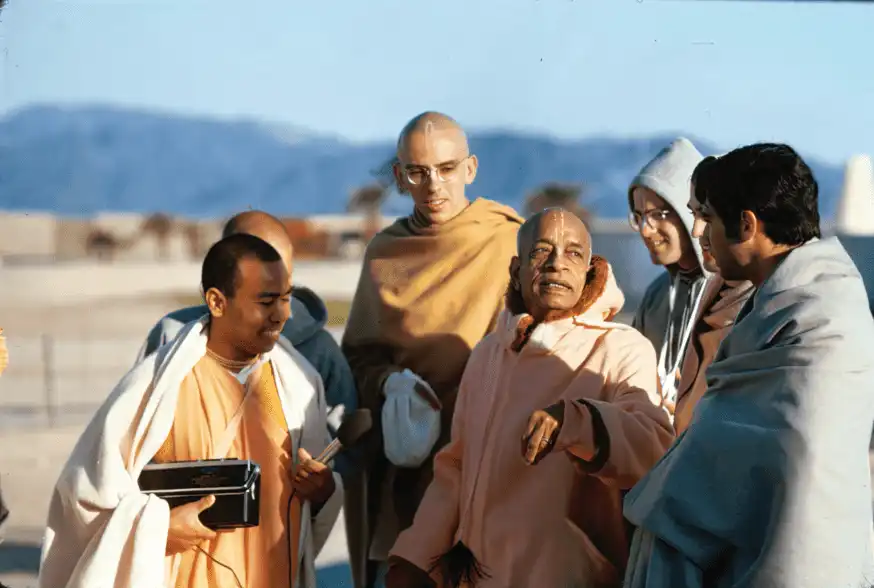
His Divine Grace
A.C. Bhaktivedanta Swami Prabhupāda first met his spiritual master, Śrīla Bhaktisiddhānta Saras- vatī Gosvāmī Mahārāja, in Calcutta in 1922. Śrīla Bhaktisiddhānta liked this educated young man and injected in him the order of preaching the message of Krşņa consciousness all throughout the world.
Śrīla Prabhupāda recalled the key to his approaching his spiritual master: “When I first started going to see my Guru Mahārāj, he said of me, ‘This boy hears very nicely. He does not go away. So I shall make him a disciple.’ That was my qualification, or whatever you may call it. I would simply ask when Guru Mahārāj would speak, then I’d sit down and go on hearing. I would understand, or not understand; others would disperse, I’d not disperse. So he remarked, ‘This boy is interested to hear.’ Because I was serious in hearing, I am now serious about kīrtanam, which means speaking or preaching. If one has heard nicely, then he will speak nicely.”
At Allahabad in 1933, Śrīla Prabhupāda was formally initiated, and in 1936, just days before Śrīla Bhaktisiddhānta Sarasvati’s departure from this mortal world, he was specifically ordered to spread Krșņa consciousness in the English language to the West.
His Divine Grace Śrīla Prabhupāda has said that at first, he did not take the mission given to him by his spiritual master with the utmost seriousness. But then he was reading a Bhagavad-gītā commentary written by Śrīla Bhaktivinode Thakur, who was the father of Śrīla Bhaktisiddhānta Sarasvati and the pioneer of the Krşņa consciousness movement in the modern age. Śrīla Bhaktivinode has written that just as one cannot separate the body from the soul while in this conditioned state, so the disciple cannot separate the spiritual master’s order from his very life. His Divine Grace A.C. Bhaktivedanta Swami Prabhupāda took these words seriously, and gradually his whole life became dedicated to carrying out the orders of his Guru Mahārāja. In 1959 he took sannyāsa, the renounced order of spiritual life, and in 1965, at the advanced age of 70, His Divine Grace arrived in New York City to fulfill his master’s sacred mission.
His Divine Grace produced his books by speaking them on a dictaphone. Sometimes he was working on five books at once. These books are a matter of realization. As he said, “When you become self-realized you automatically write volumes of books.” And one of the qualifications of a devotee is that he is poetic. Śrīla Prabhupāda was always immersed in Krsna by speaking, dictating, singing about Krsna’s glories, preaching formally at meetings or planning the expansion of the Krsna consciousness movement. In the Bhagavad-gītā, Seventh Chapter, it is stated that out of thousands of men, few seek perfection, and out of the thousands who attain perfection, hardly one knows Krşņa. Lord Krşņa also declares in the Eighteenth Chapter that the dear most devotee of all is he who spreads the teaching of love of Krsna: “Never will there be one dearer to Me.”
- In 1968, Macmillan published The Bha- gavad-gītā As It Is, translated with commentary by Śrīla Prabhupāda. The Gītā is the gist of the entire Vedic literature. Just this one book can free anyone from the clutches of material nature and fix one in eternal loving service unto Śrī Krsna, the Personality of Godhead. As originally written by Śrīla Prabhupāda, the manuscript of Bhagavad-gītā As It Is is many times larger than the version first printed. In 1972, however, the Macmillan Company published the entire 1,000-page work, thus making available for the first time a complete and definitive edition of Bhagavad-gītā.
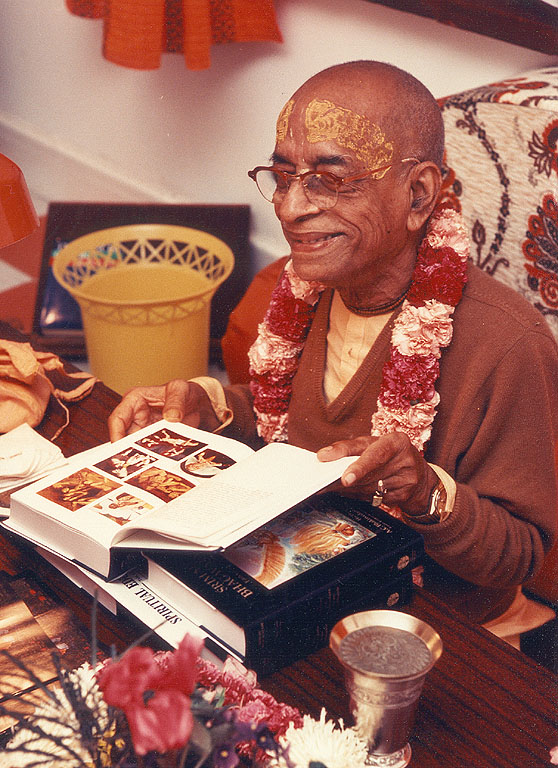
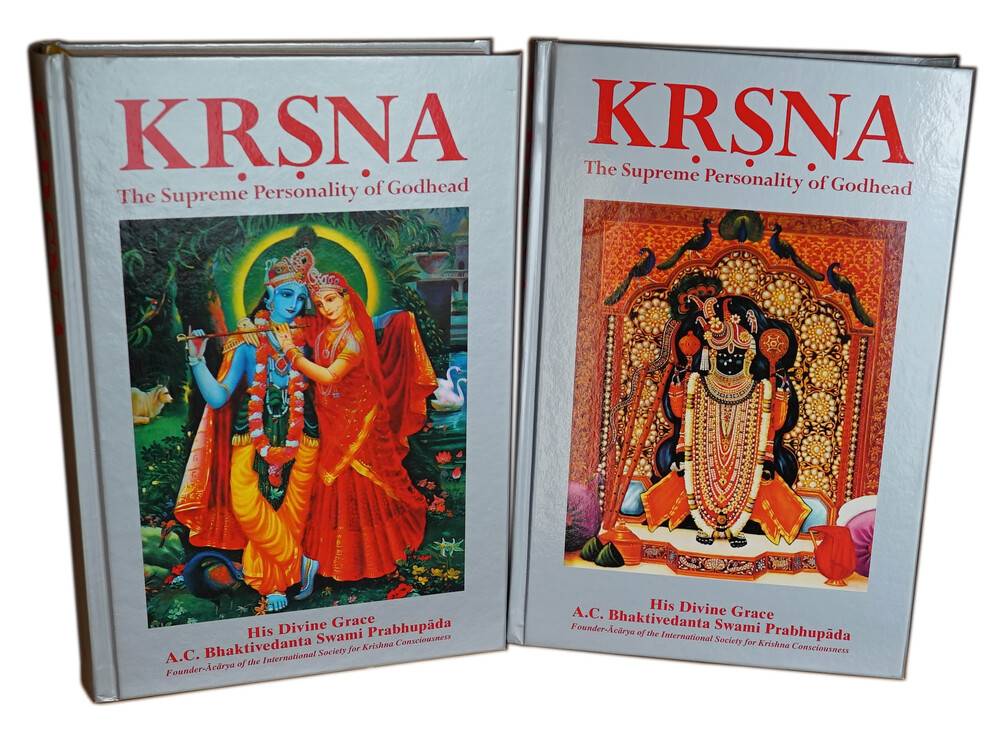
- Śrīla Prabhupāda also wrote a summary study of the transcendental pastimes of Krsna entitled Krsna, the Supreme Personality of Godhead, which has been published in a two-volume hardback edition and also as a paperback trilogy, both editions opulently illustrated in full color.
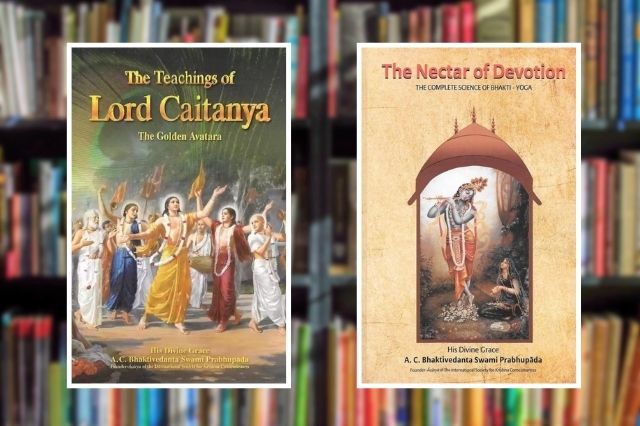
Among other important published literature by Śrīla Prabhupāda are Teachings of Lord Caitanya, which outlines the precepts of the Golden Incarnation of the Lord who appeared in India 500 years ago to propagate the Hare Krşņa mantra as the means of God’s realization for the present age, and The Nectar of Devotion, a scientific study of the development of transcendental love.
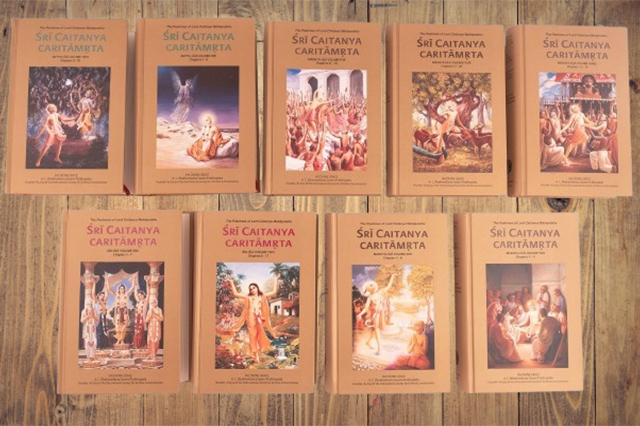
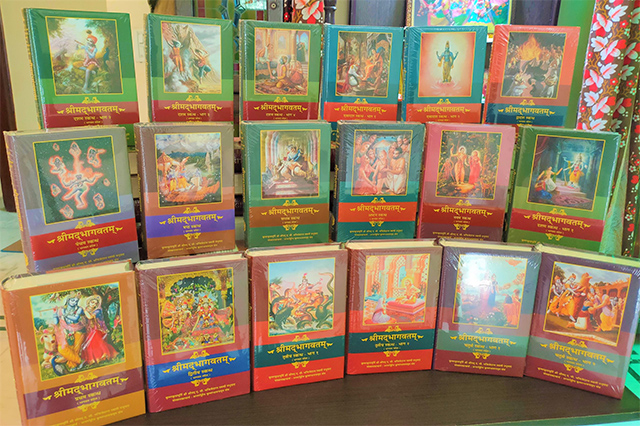
Śrīla Prabhupāda also translated the Śrīmad-Bhāgavatam in thirty volumes and the Śrī Caitanya-caritāmṛta in seven- teen volumes. The literature compiled by His Divine Grace are authorized by the disciplic succession, which is descending from Krsna Himself; Śrīla Prabhupāda’s mission is to faithfully pass on the original understanding of Krsna consciousness without distortion. Асcording to the Vedic literature this descending process is the only way to realization of the Absolute Truth, as the Absolute Truth is beyond the reach of mundane speculation or scholarship.
His Divine Grace was not a retired personality, despite his prodigious literary output. He personally and very intimately guides his disciples through the most practical problems of daily life. Spiritual life is practical and, due to the predominant material atmosphere of Kali-yuga, often problematic. As a spiritual master, His Divine Grace is the last recourse and the ultimate standard of Krsna consciousness. He wrote some twenty-five letters a day to leaders and students of his various worldwide centers. He himself resided in no one place, but travelled from center to center and regularly lectured. The spiritual master is responsible for his devotees; when he accepts a sincere soul as his disciple, he promises to take him back to home, back to Godhead. No one should think, “Oh, everyone is taking a spiritual master; let me take one.” The spiritual master as a style or as a pet is useless. Rather, his order is to be taken as one’s life and soul. By taking shelter at the feet of the bona fide guru and serving him twenty-four hours a day, the fallen soul can be lifted to the spiritual sky. It is said that if the spiritual master is pleased, then one can make great advances in spiritual life. And one pure convinced devotee can make many pure devotees by his example and teachings. Those serious students with an understanding of the absolute value of the spiritual platform of life, therefore, honor the spiritual master with the honor due to God because the guru is transparent via media or representative of God who distributes unalloyed love of God. The reader is invited to take to this philosophy with the utmost seriousness.