

The Origin of Hare Krşņa Movement
MAYAPUR HARE KRISHNA SANKIRTAN MOVEMENT
The Origin of Hare Krşņa Movement
– by His Divine Grace A.C. Bhaktivedanta Swami Prabhupäda (Founder-Acarya of the International Society for Krishna Consciousness)
Lord Śrī Kṛşņa Caitanya Mahāprabhu, the great apostle of the love of God and the father of the sankirtana movement, advanced Himself in the city of Navadvīpa in Bengal, India. This was in February 1486, by Christian reckoning.
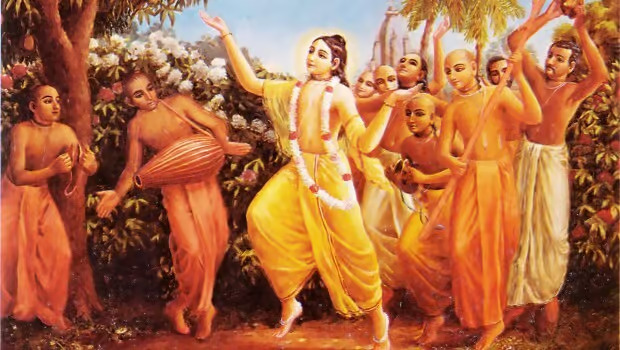
By the will of the Lord there was a lunar eclipse on that evening. It is the custom of the Hindu public to bathe in the Ganges or any other sacred river during the hours of eclipse and to chant the Vedic mantras for purification. When Lord Caitanya was born during the eclipse, then, the whole of India was roaring with the holy sound of “Hare Krşņa, Hare Krşņa, Krsna Krşņa, Hare Hare/Hare Rama, Hare Rama, Rama Rāma, Hare Hare.”
These sixteen names of the Lord are mentioned in many Puranas and Upanisads, and they are described as “Taraka- brahman,” the names for this age. It is stated in the “sästras, “the accepted scriptures, that offenseless chanting of the holy names of the Lord can deliver a fallen soul from material bondage. There are innumerable names for the Lord both in India and elsewhere, and all of them are equally good because all of them indicate the Supreme Personality of Godhead. But because these sixteen names are especially recommended for this age, called Kali-yuga, it is better for people to take the path of the great ācāryas, the saintly teachers who attain success by practicing this system.
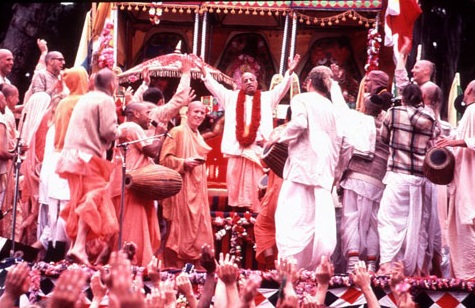
This coincidence of the Lord’s appearance and the lunar eclipse make it clear what the mission of the Lord was to be. That mission was to preach the importance of chanting the holy names of God in this age of Kali or quarrels. The present age witnesses quarrel even over trifling things, and therefore the śāstras have recommended that a common platform can be found in the performance of kīrtana, also called sankīrtana, the congregational chanting of the holy names of the Lord. Accompanied by melodious music and dancing, people can hold meetings, kīrtanas, for glorifying the Lord in their respective languages. And if such performances are executed in an offenseless manner, it is sure and certain that such persons will gradually attain spiritual perfection with- out any of the effort of undergoing rigid methods of yoga or asceticism.
During sankīrtana the learned and the fool, the rich and the poor, the Hindu and the Moslem, the Englishman and the In- dian, the common man and the priest-ali can give aural reception to the transcendental sound vibration of Hare Krsna, and thereby cleanse the dust from the mirror of the mind.
In the Śrīmad-Bhāgavatam, it is stated, “In this age of Kali, people who are endowed with sufficient brain substance will worship the Lord and His associates by the performance of sankīrtana-yajña (sacrifice).” So Lord Caitanya and His inauguration of the sarikīrtana movement were not concoctions, but present the fulfillment of what is stated in revealed scripture, just as the appearance of Lord Buddha, Śańkara Ācārya and all such avatāras are foretold in Vedic literature. And to confirm the Lord’s mission, all the people of the world will accept the holy name of God as the com advent of the holy name thus took place along with the advent of Lord Śrī Caitanya Mahāprabhu. When the Lord was on the lap of His mother, the child would at once stop crying as soon as the ladies surrounding Him chanted the holy name, clapping their hands. This peculiarity was observed by the neighbors of the Lord with awe and veneration. Sometimes the young ladies took pleasure in making Him cry, so that they could then stop Him by chanting Hare Krşņa, Hare Rama. From His very childhood, then, the Lord began to preach the importance of the holy name.
At the age of sixteen, He became the greatest scholar in all India, known as Nimai Pandit. He was then married with great pomp and began to preach the Hare Krşņa movement at Navadvīpa. Some of the brāhmaņas there soon became envi- ous and put many hindrances in His path, at length complaining to the Moslem magistrate about Him. The Kazi, as this official was called, took these complaints seriously, and he at first warned the followers of Lord Caitanya not to chant the name of Krsna loudly. But Lord Caitanya asked His followers to disobey the orders of the Kazi, and they went on with their sarikīrtana parties as usual.
The Kazi then sent constables who broke some of the mridangas (drums) while sankīrtana was taking place. When Lord Caitanya heard of this, He organized a civil disobedience movement at Navadvīpa. He was the pioneer of civil disobedience in India and for the right cause. He organized a procession of a hundred thousand men, with thousands of mridangas and karatalas (hand cymbals), and the procession passed over the roads of Navadvīpa without any fear of the Kazi.
At length, the party reached the house of the Kazi, who flew upstairs in fear of the masses. The men assembled there showed hot tempers, but the Lord asked them to be peaceful. At this, the Kazi came down, and a very nice discussion was held concerning the Koran and the Hindu Śāstras.
The Kazi questioned the Lord about cow sacrifice, which is prescribed in the Vedas, and the Lord replied that the sacrifice mentioned in the Vedas is not cow killing. In that sacrifice, an old bull or cow is killed to give it a fresh, younger life by the power of the Vedic mantras. In the Kali-yuga, however, such cow sacrifice is forbidden on account of the absence of learned brāhmaņas who can conduct the ceremony. In the Kali-yuga all sacrifices are forbidden because they are useless at tempts when undertaken by the unlearned. In the Kali-yuga only the sankīrtana form of sacrifice is recommended for all practical purposes.
The Kazi was convinced by the authority of Lord Caitanya and at once became a follower of the Lord. He declared that, thenceforward, no one might put hindrances in the way of the Hare Krsna movement.
Following this incident, the Lord began to preach and propagate sankirtana more vigorously than ever. In the course of His preaching work, He used to send out all His followers every day, including Śrīla Nityananda Prabhu and Thakur Haridāsa, two chief figures of His party. They would go from door to door and preach the cult of Srimad-Bhagavatam, the science of love of Krsna. One day, as they were out on the road, these two came upon two brothers named Jagāi and Mādhāi. Born the sons of a respectable brāhmaņa, the brothers had fallen to the most despicable position through low association. They were de-bauches of the first order, meat eaters, woman hunters and dacoits.
At once, upon learning of these two, Thākur Haridāsa and Nityānanda Prabhu decided that if they could be delivered by the holy name, Lord Caitanya would be all the more glorified. With this in mind they at once approached the two brothers, requesting them to chant the holy name of Krşņa. The drunken brothers became enraged at this, however, and attacked Nityananda Prabhu. Both Nityananda Prabhu and Haridāsa Thākur hurriedly left the place, with the drunkards chasing them for a considerable distance.
The next day Nityānanda Prabhu again came to see the brothers, but as soon as he approached them he was struck on the head with a piece of earthen pot, and blood spilled forth. Śrīla Nityānanda was so kind toward them that instead of protesting against their heinous act, he said, “It doesn’t matter that you have thrown things at me. Still, I request you to chant the holy name of the Lord.”
One of the brothers was astonished at this behavior of Nityananda Prabhu, and he at once fell down at his feet, asking pardon for his sinful brother. The other was again attempting to hurt him, but Jagāi checked him and implored him to also fall down at the feet of Nityananda Prabhu.
Meanwhile, the Lord, having heard of His devotee’s injury, at once rushed to the spot determined to kill the pair, but Nityānanda Prabhu reminded Him of His mission- namely, to deliver the hopelessly fallen souls of the Kali-yuga. The brothers Jagāi and Mādhāi were, after all, typical examples of the present-day population. Because of Nityananda’s intervention, and due to their own sincere surrender at that pure devotee’s feet, Lord Caitanya at length was pacified, and the brothers became welcome devotees of God.
For this purpose of delivering the debased population of the Kali-yuga, Lord Caitanya appeared, and out of His causeless mercy He gave us the simple method of self-real- ization-chanting the holy name of God: Hare Krşņa, Hare Krşņa, Krsna Krsna, Hare Hare/ Hare Rama, Hare Rāma Rāma, Rāma, Hare Hare. And, He said there is no other way in this era.
When the Lord was once asked by the great Māyāvādi sannyāsi, Prakāśānanda Sarasvati, what was the reason for His di- version to the sankirtana movement, instead of studying the Vedanta-sūtras as is the duty of a sannyāsī, the Lord replied very humbly as follows:
- “The reason for My diversion to the sarikīrtana movement from the study of the Vedānta is that I am a great fool. And, because I am a great fool, My spiritual master forbade Me to play with Vedānta philosophy. He said it would be better for Me to chant the holy name of the Lord, and that would deliver Me from material bondage.
- “In this age, there is no religion other than glorifying the Lord by the utterance of His holy name, and that is the injunction of all the revealed scriptures. So on the order of My spiritual master, I chant the holy name of Krşņa, and I am now mad after this holy name. Whenever I utter it, I forget Myself completely; sometimes I laugh, sometimes I cry, and sometimes I dance like a mad- man. I thought within Myself that I may have actually gone mad by this process of chanting the holy name, and therefore I inquired from My spiritual master about it.
I told him, ‘I have become mad by chanting the holy name. What does this mean? Please let Me know.”
- “My spiritual master then informed Me that it is the real effect of chanting the holy name that it produces transcenden- tal emotion, which is a rare manifestation. This transcendental emotion is the sign of love of God, which is the ultimate end of life. The love of God is transcendental even to liberation (mukti), and as such it is called the fifth stage of spiritual realization- standing above the stage of liberation. The actual result of chanting the holy name of Krşņa is to attain the stage of love of God, and it was good that I was favored with such a blessing.”
Although Lord Caitanya is Krşņa Himself, for our example He has presented Himself as a great fool. God is full of six opulence, including all knowledge, and therefore He is never a fool. We can, however, follow the merciful example of Lord Caitanya and take up this chanting with all determination, and we will in that way reach the ultimate perfection of life, which is the love of God. Everything is there. We need only accept what is coming down to us in the line of disciplic succession from Krşņa and from Lord Caitanya.